(and the rest of Brazil) Brazil’s Congress Takes Chainsaw to Critical Environmental Laws
Anthony Calacino - 7-9 minutes est. reading time
On November 16, Brazil’s Congress took a chainsaw to the country’s environmental regulatory framework. The law known formally as 15.190/2025, or informally as the Bill of Devastation, passed with 231 to 87 votes in Brazil’s lower chamber of Congress (see geographic distribution below). In the short term, the law will ease the process of environmental licensing by bypassing formal review for some projects. In the medium term, it will make it much harder for Brazil to reduce deforestation in places like the Amazon, as the law weakens the rural property registry used to track illegal deforestation and other measures. The law also might make it easier to for environmental fines to be anulled. Moreover, the law could limit Brazil’s chances to meet its international climate commitments. Initially, and as many had expected (including myself), Brazil’s President Luiz Inácio "Lula" da Silva vetoed key elements of the bill; yet, two weeks ago, Congress voted to overturn the President’s veto by a nearly identical supermajority.
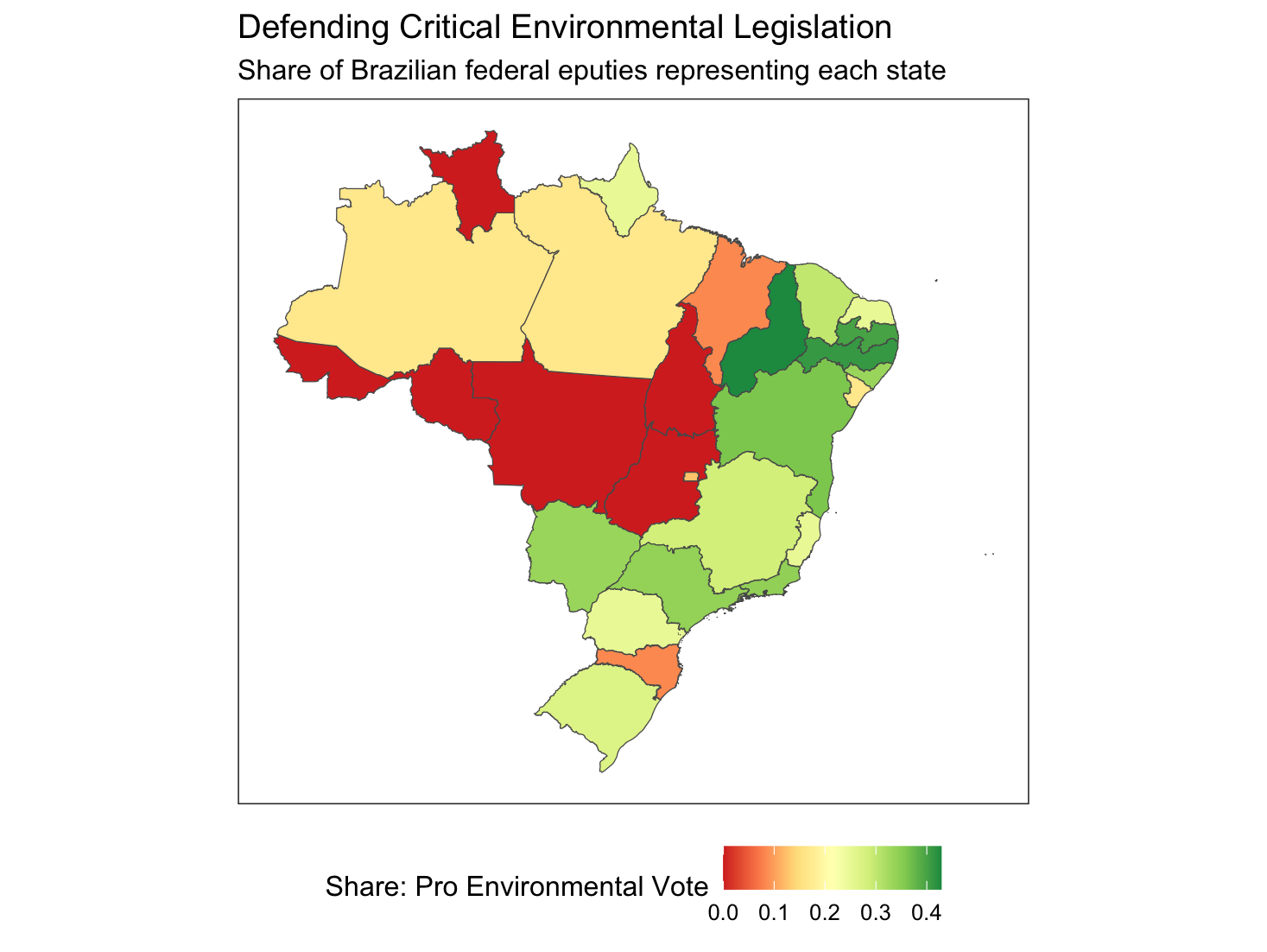
These developments are a seismic shift in Brazil’s environmental politics, and will have numerous repercussions, especially for the country’s ecosystems and indigenous peoples who are on the front lines of the extractive economy. The audacity of passing this law just weeks after the United Nations climate conference took place in Brazil makes the brazenness seem intentional.
On the surface, this law’s passage can partially be explained by the substantial influence of agribusiness in Brazil’s national politics, which for decades has seethed at environmental rules and enforcement. While agribusiness’ influence helps explain how this law became a possibility, it’s an incomplete explanation. Rather, I argue, the new law’s passage is explained by the process of political entrenchment of agribusiness over the years, which has lowered the costs of dismantling environmental protections, and emboldened legislators to retaliate against regulators who have sanctioned their constituencies.
The rest of this post explores how Brazil’s agricultural elites organized around other interests before turning to environmental regulations, their various methods of political embedding, and how the environmental sanctions have been met with a backlash.
1. The Political Economy of Agrarian Elites and Environmental EnforcementAgribusiness in Brazil did not politically organize only to seek relief from environmental regulations. Ranchers and landowners first organized in Brazil for other political aims. Agrarian elites first mobilized around the 1988 constitutional assembly, with ruralists fearing threats from the National Program for Agrarian Reform (PNRA) proposal, and a wave of land occupations that were occurring throughout the country (Bruno 2017). As a recent book on this topic has argued, the PNRA acted as an “existential” threat which helps explain why agrarian elites chose electoral strategies over non-electoral strategies to influence politics (Milmanda 2024). Since the 1980s, Brazil’s agrarian sector has continued its political endeavors. For example, agrarian elites are successful in receiving net transfers through huge subsidies and discounted loans backed by public accounts.
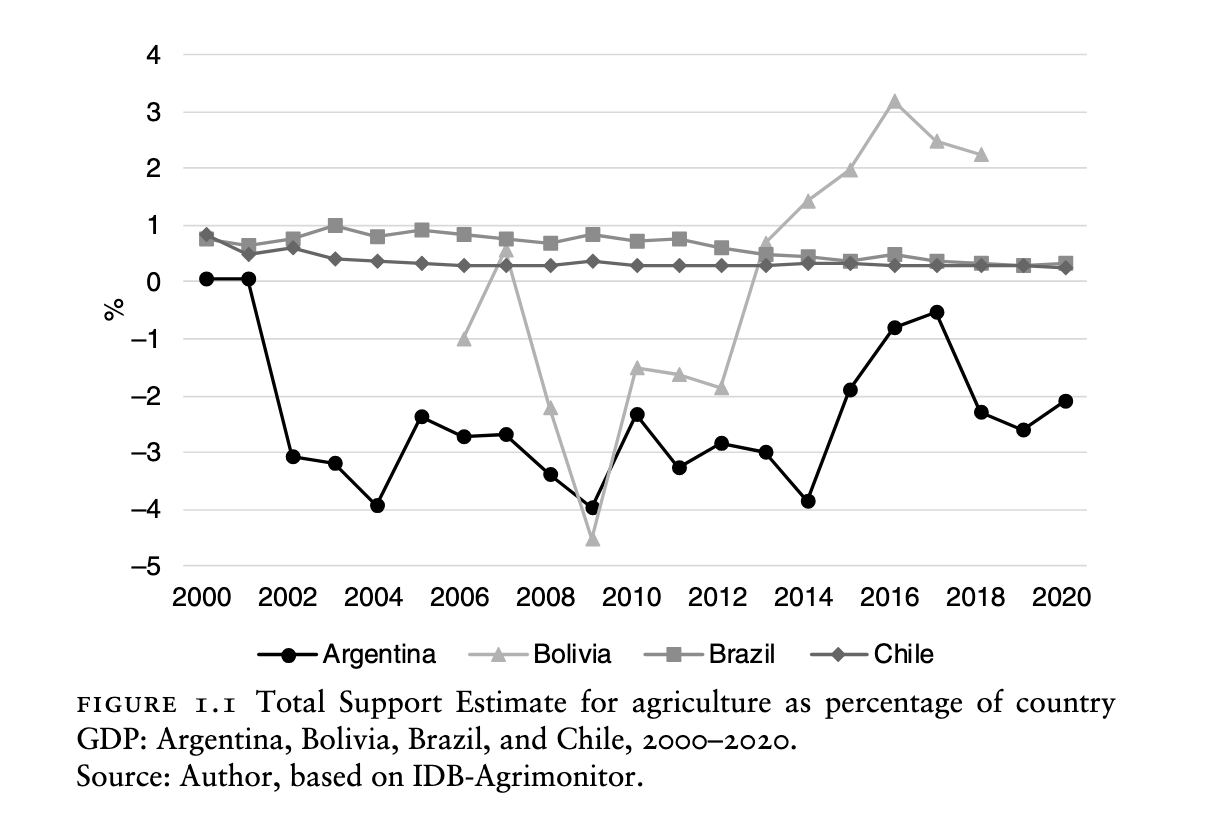 Source: Milmanda 2024 page 3.
 2. How Agrarian Elites Practice Politics
The main political manifestation of agrarian elites in the national Congress is called the Rural Caucus (Bancada Ruralista in Portuguese). Some estimates suggest the Rural Caucus maintains at least 30% of the lower chamber’s 513 federal deputies as members; other estimates put that number as high as 50%. Either estimate makes the caucus the largest single political force in the country’s lower chamber beyond any single party; though, calculating active membership is a bit tricky due to the ease of becoming a member.
The Rural Caucus works on all parts of the legislative cycle. It promotes draft legislation, works to set the agenda, is an important actor around the President’s coalition (one feature of coalition presidentialism identified in Brazil and some other cases), and also seeks to influence national conversations through a number of public relations materials and campaigns. The Rural Caucus also organizes campaign finances. In addition, a number of ranchers and elite landowners have successfully run for office; increasingly, Brazil’s political class (at least in some states) is the same as its economic elites. Despite its relative importance, the caucus is somewhat secretive. In my over two years of time spent in Brazil for research, and in dozens of interviews with elected officials, I have had only small glimpses into the inner workings of the Caucus. Really, what I have come to believe is that the Rural Caucus is simply a shell: it transmits the workings of a much denser and larger network of agrarian elites that go well beyond associated elected politicians.
3. Environmental Sanctions Trigger a Backlash
Securing all of this power puts anyone who crosses agrarian elites in deep political danger. Hence, it’s no surprise that one of the most contentious federal governmental agencies in Brazil today is the one tasked with enforcing environmental crimes for things like illegal deforestation, which is the primary way rural landowners clear new land to make way for lucrative cattle grazing. Ibama, the acronym for the main environment agency, not only annoys Rural Caucus members, it is also outright hated. In several interviews with Rural Caucus politicians, Ibama and other environmental agencies like ICMBio and FUNAI were accused of holding back Brazil’s development and advancing “foreign” aims. In one interview, a Federal Deputy told me with a straight face he believed Ibama and ICMBio were a left-wing conspiracy to take down the country’s ranchers.
To some extent, environmental agencies do cause headaches for the Rural Caucus. In fact, public data reveals that in 2022, at least 16 federal deputies had a combined R$ 1 million in outstanding fines by Ibama for crimes like deforestation and fires on their properties. Variation in derision for environmental laws among the country’s lawmakers is likely explained by the distribution in where Brazil’s environmental regulator has sanctioned crimes in the past, as even when lawmakers are not directly targeted, fellow ranchers and landowners – their constituents - have been. The map below plots the total amount of environmental fines applied since 2019 to each of Brazil’s states. At first glance, the map shows the Amazon is a hotspot, in addition to states like Minas Gerais and Espírito Santo.

Simple regression analysis - though take with a grain of salt given the small number of observations - suggests that the total amount of fines may more accurately correlate with how lawmakers from each state voted on the Bill of Devastation compared to the share of each state’s economy that comes from agribusiness:
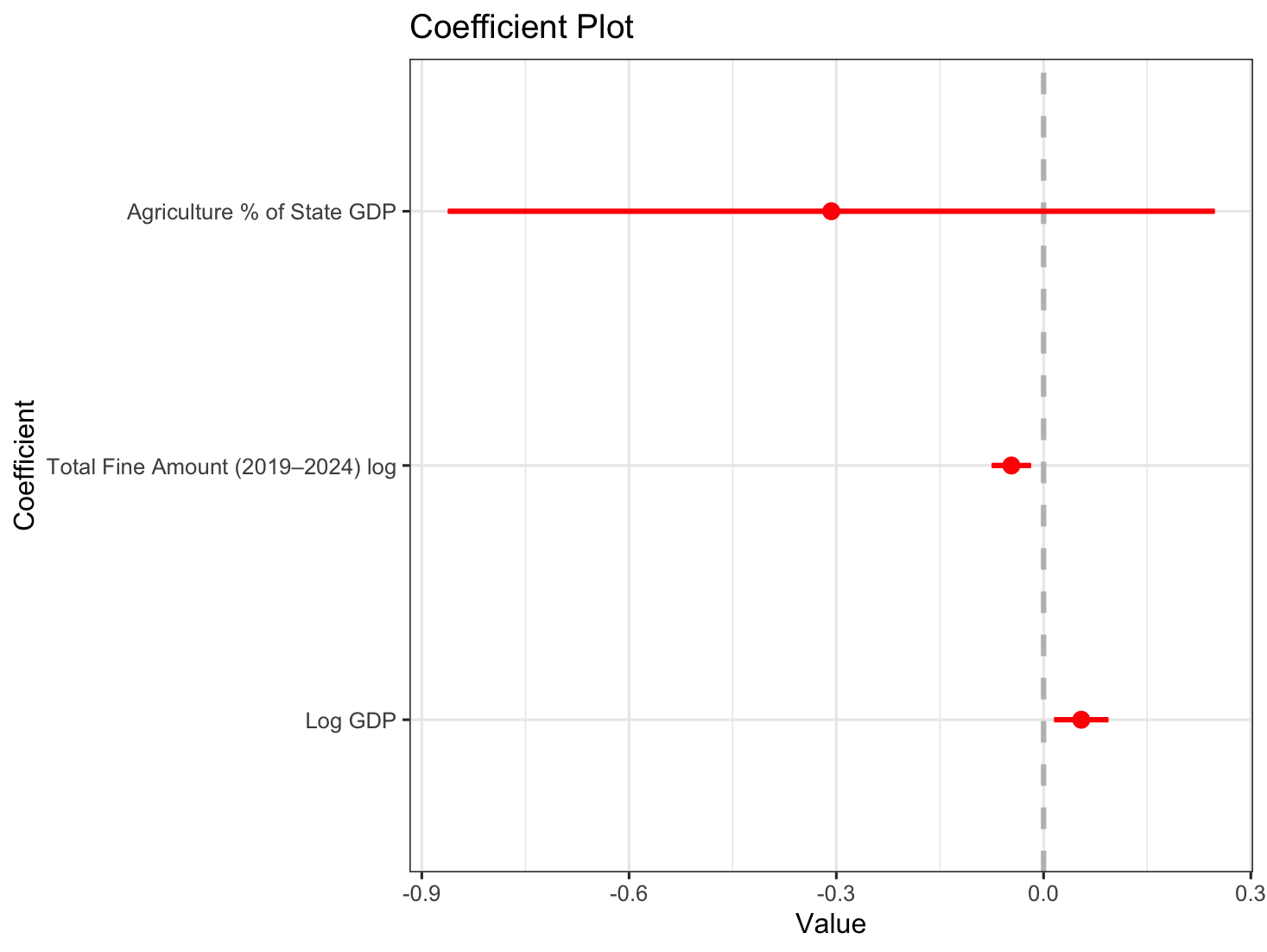
OLS regression analysis for Brazil's 27 states where outcome is the share of deputies for each state voting against the Bill of Devastation in November 2026 (i.e., a pro-environmental vote).
While only correlational, these data suggest a political economy that links those committing environmental crimes to national politics. Many of my over 200 interviews (for my book project in which I dive much deeper into the politics of environmental enforcement) also support the idea that the Rural Caucus and the wider network of political actors representing agrarian interests are now using their consolidated power to render environmental regulation and enforcement moot. In talking with former leaders of Ibama, former ministers of the environment, Rural Caucus members, and civil society, it is clear that the prevailing goal of agrarian elites is to reduce Ibama and other agencies to a skeleton staff and defang enforcement. While ex-president Jair Bolsonaro was dutifully critiqued for going after the environmental agencies, the real threat is the consolidating power of agrarian elites in the country’s Congress. For more evidence of this, below is a figure based on numbers given to me by a Ministry of Environment employee; these are the federal deputies who visited Ibama in 2024 (a municipal and state election year) to raise complaints about an environmental sanction on behalf of constituents. These numbers suggest over 51% of Brazil’s federal deputies, or someone from their office, visited Ibama in a single calendar year.

4. Alternative explanations
Other explanations for the legislative attack on Brazil’s environmental regulations exist. One is that the country has become more right-wing politically, and the public is aligned with these environmental changes. While there is some basis to a rightward shift in public voting, in opinion polls, Brazilians overwhelmingly say they support Ibama. For instance, in a small survey I conducted with a stratified online sample in 2023 (n = 1030), over 93% of respondents had heard of the agency, and all but nine of those respondents correctly remembered that the agency worked on protecting the environment. Knowledge of the agency does increase slightly with income, education, and voting more left-wing. Still, amid this high knowledge on average, over 76% of respondents also believed Ibama’s funding should be increased to better protect the environment, while only a little over 12% believed it should be decreased and the rest believed the current funding is adequate. Given this level of support, it is quite unlikely the attacks on environmental legislation are supported by the public at large.
Another potential explanation is that since the country is facing slow economic growth, removing costly environmental regulations is seen as necessary to jump start the economy. Yet, Brazil’s economy is only sluggish compared to a handful of countries like India and China; actually, since 2021, the country’s economy has grown faster than countries like Chile and Mexico on average. Instead, most researchers and economists will tell you Brazil’s economic woes are due to its public finances, white-collar corruption, tax schemes, trade restrictions, flagging industrial policy, and structural economic and racial inequality - environmental regulations hardly factor.
5. Conclusion
In short, Brazil’s attack on its environmental regulations was heavily fought for by a political force that has been consolidating power since the 1980s. This makes the changes no less shocking. Going forward, watch for worrying signs from the country in terms of devastation to some of its most important biomes. I am particularly worried about the Mata Atlântica, the country’s east coast rainforest which is often overlooked; today, less than 5% of the Mata Atlântica remains, and the new environmental legislation has drastically weakened the forest’s legal protections. Another thing to watch for is an increase in illegal mining in the Brazilian Amazon. At the start of the third Lula presidency in 2022, devastation from mining in the Yanomami indigenous territory sparked global outcry and the government quickly mobilized Ibama and other agencies to deal with it. Now, with less credible threats of enforcement, coupled with the surging price for gold and silver, I fear illegal mines will again encroach on protected areas. In addition, the global shortage of beef (partly due to climate change factors) is driving prices higher globally, which could stimulate more deforestation in Brazil amid the relaxed rules. Making matters worse, 2026 is an election year for the country, which we know often means federal deputies and senators running for re-election will intentionally impede enforcement of deforestation for political gains. While early indicators point to the left-wing Lula being the frontrunner, and he does have some commitments to environmental protections, it is Brazil’s Congress we must watch for the fate of the Amazon and Brazil's other ecosystems.
References:
Bruno, R. (2017). Bancada ruralista, conservadorismo e representação de interesses no Brasil contemporâneo. In R. S. Maluf & G. Flexor (Orgs.), Questões agrárias, agrícolas e rurais: Conjunturas e políticas públicas (e-book). E-Papers.
Milmanda, B. F. (2024). Agrarian elites and democracy in Latin America. Cambridge University Press.